.png)
Don't Take the BAITT: 5 Manipulation Tactics Every Couple Uses Without Realizing It

Plus: why you keep falling for these tactics even when you can see them coming — and a three-step system to hold your ground.
If you’d like the full explanation, you can watch the YouTube video above. If reading is easier, I’ve included a shortened illustrated guide below.
Why This Matters
Most difficult conversations in relationships don't go wrong because of what was said. They go wrong because of what wasn't said — and what was done instead. When asking directly for what you want feels too risky, people reach for ways to covertly get the result without the vulnerability.
That's what manipulation is — not always calculated, not always conscious, but almost always protection in disguise. This guide will show you the five most common manipulation tactics in relationships, why they work so reliably on even the most self-aware people, and a three-step process for holding your ground when you're on the receiving end.
Blue and Yellow have agreed in principle to move closer to Yellow's job. But every time the conversation comes up, it goes sideways. Neither one says what they actually want. Instead — without really realizing it — they reach for manipulation tactics.
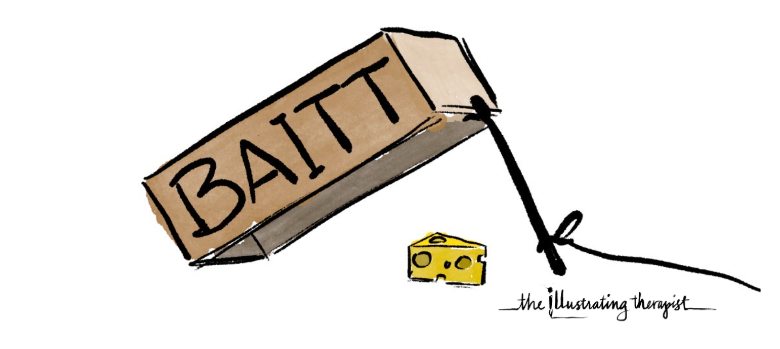
The 5 Manipulation Tactics: BAITT
B — Blame

Yellow: "We agreed to this. You're the one holding everything up. We would already be there if it weren't for you dragging your feet."
Blue feels his stomach drop. He apologizes, explains that the timing at work has been complicated, and promises to talk to his boss first thing Monday. The conversation ends. Yellow got what she wanted — and Blue feels like he's been run over by a truck.
Here's what happened: Yellow didn't state a preference. She assigned fault. And the moment Blue accepted that he might be at fault — even partially — he stopped negotiating and started trying to make it right.
The belief Blame triggers is: I am at fault. The feeling that follows is guilt. And guilt is one of the hardest feelings to sit with, because it comes with a built-in instruction — fix it. You give in not because you've changed your mind, but because giving in feels like the only way to make the guilt stop. Blame doesn't have to be accurate to work. It just has to land.
A — Argue
Blue: "I never agreed to your timeline. We never even set a timeline. You just assumed we did."
Blue comes back – contesting every detail — the conversation, the month, the specific words that were used. Eventually Yellow says: "Fine. Maybe I got the timeline wrong." Blue gets more time without ever once asking for it.
What happened? Blue didn't state a preference. He contested the facts. And the moment Yellow started questioning whether she had it right, she stopped talking about what she wanted and started trying to prove she wasn't wrong.
The belief Argue triggers is: I am wrong. The feeling is defensiveness. When someone contests the facts of a situation, the almost irresistible response is to prove your version. But that is the moment that you've accepted that one of you has to be wrong. You give in not because you've been persuaded, but because you got so focused on proving you weren't wrong that you lost sight of what you actually wanted.
I — ID as Victim
Yellow: "I've given up so much for this relationship. I turned down a promotion for us. I handle everything at home. This is the one thing that would actually make my life better. I guess I'll never get what I want."
Blue goes quiet. He thinks about everything she does, about the promotion she turned down, about how hard she works. He feels terrible. He says — "You're right. I hear you. I'll figure it out." Yellow feels better. Blue feels terrible.
Here’s what happened: Yellow didn't state a preference — she repositioned herself as the one who has suffered most. And the moment Blue accepted that he was the cause of her suffering, he stopped negotiating and started trying to fix it.
The belief ID as Victim triggers is: I am the problem. The feeling is shame. This one is the hardest BAITT move to spot because it's often partially true and that grain of truth is what makes the shame stick. You give in not because you want to, but because you can't bear to be the reason someone is hurting.

T — Twist Reality
Blue: “"You are treating this like a crisis. It's just a conversation with my boss. It takes five minutes. You are making this such a big deal."
Yellow stops. Maybe she's been making this bigger than it needs to be. Maybe she's the one causing the problem. She came in certain. She's leaving unsure.
What happened? Blue didn't state a preference — he reframed her concern as the real problem. Now she's not just questioning the fact. She's questioning her own judgment.
The belief Twist Reality triggers is: my memory and perception are unreliable. The feeling is confusion. This move is uniquely destabilizing because the other four BAITT moves target what you did or how you feel — this one targets your grip on what reality.
And a person who can't trust their own version of events will almost always defer to the person who seems more certain. You give in not because you were persuaded, but because you could no longer trust yourself.

T — Threaten Emotional Reaction
Yellow doesn't bring up the move that evening. She doesn't bring up anything. Dinner is quiet. Her answers are clipped. She goes to bed without saying goodnight, and a dark mood descends over the house. Blue runs through the day in his head — is this about the move? It's probably about the move. Her silence feels like a wall. The next morning she's still distant and leaves for work without a word.
By lunchtime Blue texts: "I talked to my boss. My last day is May 31." That evening, Yellow is warm again.
The belief Threaten Emotional Reaction triggers is: this is unbearable. The feeling is anxiety. This is the most covert BAITT move of all — no demand was made, no voice was raised, the move was simply to pollute the emotional environment and wait. The silence does the work.
You give in not because of anything that was said, but because the atmosphere became so uncomfortable that doing the thing felt like the only way to get relief. Yellow never asked for anything. She just withdrew — and Blue eventually gave in.

How the Trap Works — At a Glance
Each BAITT move works the same way. The tactic triggers a belief. The belief triggers a feeling. And that feeling drives you to give in — usually before you've even realized what happened.

Why You Keep Falling for It

Here's the uncomfortable part. It takes two people for manipulation to work. Every time you justify your position, accept their version of events, doubt your own memory, or launch into an explanation — you're not defending yourself. You're handing over your equal footing.
The reason this is so hard to catch in real time is that it doesn't feel like giving in. It feels reasonable. It feels like being a good partner.
There's a name for this response pattern and here is my version of it:
J — Justify your actions.
A — Accept their view of events.
D — Doubt yourself.
E — Explain your side.
Justifying and explaining yourself feels like transparency. Accepting your partner's version of events feels like humility. Doubting yourself feels like self-awareness. These feel like things good partners do — and in a good-faith conversation, they are. But manipulation isn't a good-faith move. And when you respond in good faith to a bad-faith move, you're playing by completely different rules without knowing it.
Every time you JADE, you give the manipulation something new to grab onto — a new detail to contest, a new justification to dismantle — and you hand over your equal footing without realizing it.
Permission
Before we get to the solution — here's something nobody says out loud.
You are allowed to feel guilty — and not change your answer.
You are allowed to have been wrong — and still want what you want.
You are allowed to want something different than your partner — and still hold your position.
You are allowed to be confused — and still say "I need more time."
You are allowed to feel anxious — and still hold firm.
Your partner's feelings are real. And they don't automatically override yours. Feelings are information. They're not imperatives.
The 3-Step Response: ARC

Instead of JADE-ing, you ARC over the trap. ARC stands for Agree, Repeat, and Curiously Question — three moves that let you stay in the conversation, hold your ground, and get back to equal footing without defending, without explaining, and without taking the BAITT.
A — Agree With What You Can
When blame lands, the instinct is to defend. But defense signals guilt. Instead, find the grain of truth — and agree with just that.
"You're right — I haven't talked to my boss yet. And I know that must be frustrating."
That's it. Nothing more. Blame needs resistance to function. When you agree with what's genuinely true — calmly, without collapsing — you disarm the emotional charge without giving up your position. Your partner came in with a trap. You ARCed over it.
R — Repeat Your Preference
When pressure mounts, the instinct is to explain, but every explanation gives the manipulation something new to grab onto. Instead, just say what you want. Simply. Without justifying it.
"I'd like 2-3 weeks to figure out the best time."
"That's not what you promised."
"It's what I'd like now."
No new information. No new vulnerability. Just the preference, restated calmly. Your partner wanted a debate. You gave them your position.
C — Curiously Question
When your partner escalates, the instinct is to defend or retreat. Instead, get curious about what they actually want — underneath the tactic.
"What is it about the timing that feels so urgent right now?"
"What is it specifically about waiting that feels so hard?"
"Is it less about the timeline — and more about whether this is actually going to happen?"
Every BAITT move is a covert way of getting something without asking for it directly. Curious questioning invites your partner to stop being covert — to say what they actually want out loud – on equal footing.
One Last Thing
ARC doesn't mean feeling nothing. Blue felt the guilt and the defensiveness every single time — he just chose not to act on it. That's the skill. You do it guilty. You do it defensive. You keep going until it starts to feel natural. Because your feelings are information. Not imperatives.
For more illustrated explanations of relationship patterns like this one, visit my YouTube channel: The Illustrating Therapist.
Wow, Lara- such clarity! I love how you think these things through. Thank you!