.png)
The Real Reason Viktor and Maria Are Stuck — And What It Reveals About Your Relationship

Updated: May 4
A visual guide to three conflict patterns — seen through the story of Viktor and Maria from Netflix's Blue Therapy.
If you’d like the full explanation, you can watch the YouTube video above. If reading is easier, I’ve included a shortened illustrated guide below.
Viktor and Maria
Viktor and Maria have been together for seven years. From the outside, their relationship looks solid — they have a shared life, a shared history, and genuine love for each other.
So why are they in couples therapy unable to agree on a single fact about their own relationship?
This guide uses a framework called the Door Between Us. Imagine two people, each standing in their own room, with a door between them. When both people keep that door open — saying what's true for them, and genuinely hearing what's true for their partner — connection becomes possible.
That green glow of connection — the trust, care, love, and affection that make a relationship worth having — only grows when the door stays open. It can't be demanded. It can't be pulled through a closed door. It blooms slowly, in the right conditions.
Viktor and Maria are using three different ineffective conflict styles. You may recognize one or more in your own relationship.
Style 1: Shut the Door
Several years ago, Viktor gave Maria a ring. She understood it as a promise — a symbol of where they were headed. Viktor never corrected that. Not when she received it. Not when she told people about it.
That silence wasn't nothing. When something important comes up and you go quiet instead of saying what you actually think, that's what Shutting the Door looks like. You're still in the relationship, but your door is closed.

Viktor also says something that reveals where this habit comes from: "No one has ever understood me. I've always been a little different." He learned early that the safest thing to do was close the door — before anyone else could close it on him. He isn't shutting Maria out to hurt her. He's protecting himself the only way he knows how.
But here's the cost. What Viktor experiences as a peaceful relationship is actually a protected one. Maria has been living on the other side of that door, wondering why she can't get in. And Viktor says he feels most disconnected from her during disagreements — without realizing that the disagreements aren't the problem – his closed door is.
What helps: Notice when you go quiet about something that actually matters to you. Try naming one true thing, even a small one. Staying in your own room means saying what's there — and leaving the door open so your partner can do the same.
Style 2: Choose to Lose
On the other side of Viktor's closed door, Maria was making her own quiet decisions.
Maria has been sending her family money — without telling Viktor. Not because she's trying to be deceptive, but because she'd learned over seven years that certain topics bump up against Viktor's closed door. Her family is one of them. So she stopped bringing it up to keep the peace.
That's what Choosing to Lose looks like. You don't fight. You don't push. You just quietly set aside what matters to you — because the alternative feels worse.

Choosing to Lose means that you've walked out of your own room and gone to stand in your partner's. You've stopped saying what's in your space. And because you haven't spoken up, your partner may not even know you're making a sacrifice.
Eventually, Maria hit something she wasn't willing to give up. So she quietly started sending money anyway — without telling Viktor. That's when Choose to Lose crossed into something else: her own door closing.
Viktor frames this as a respect issue. And on one level, he's right — she wasn’t honest with him. But underneath that, she didn't tell him because she'd already learned they can't have this conversation with both doors open.
There's no green glow of connection when Maria abandons her room — and none coming through either of their closed doors.
What helps: Ask yourself what you've been going along with that you actually have a preference about. Going back into your own room and saying what's there — even gently — is how connection gets rebuilt.
Style 3: Pull to Win
Now they're here — seven years of avoided conversations, a ring that was never defined, money that was never mentioned — and the decision about marriage is forcing all of it into the open at once.
Viktor's position: convince me. Tell me why we need it. Give me a reason. And until you do — I'm fine where we are.
That sounds like an open question, but it isn't. Viktor has appointed himself the objective judge of whether marriage is necessary. Maria has to make her case to his satisfaction, so he wins by default.

So Maria tries harder. She over-explains. She makes her case again, a different way, hoping this time it will land. She has stepped over the threshold into his room and is pulling on him to come to her side. That's Pulling to Win — and it's another way for the relationship to lose. You can't create connection from your partner's room.
The loop this creates is exhausting: the more Maria explains, the more Viktor holds his position. Neither is keeping the door open. Neither is saying what's actually true for them. And neither is staying curious about what's true for the other.
One couple. Three ineffective conflict styles. Zero green glow of connection.
What helps: When you notice yourself explaining the same thing for the third time, that's a signal. Step back into your own room. Say what the situation means to you — not what your partner should think about it. And stay open to being surprised by what they say back.
Keeping the Door Open
So what would it actually look like if both Viktor and Maria kept the door open?
For Viktor — something like: “Marriage makes me uncomfortable and I don't fully understand why. I need to figure that out.” That's a man standing in his own room, telling the truth about what's in it.
For Maria — something like: “This matters to me deeply, and it's important that you understand why — not just rule on it.” That's a woman standing in her own room, telling the truth about herself.
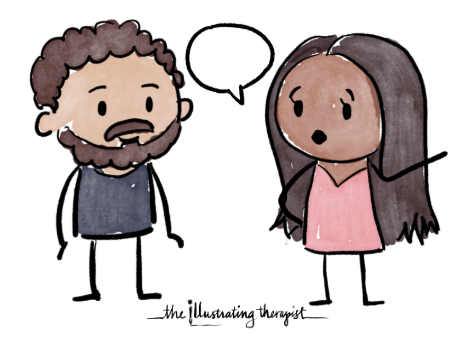
Because this was never really about marriage. Maria grew up in a world where family is structural, where institutions matter, where a ring means something publicly — not just privately. Marriage is belonging. It's next of kin. It goes all the way to the core of who she is.
Viktor grew up feeling like no one understood him. He built a world where he only needs one person — and that person is Maria. To him, their bond doesn't need a ceremony to be real. But his closed door is putting that one person at risk. Maria is not going to choose to lose forever. And if Viktor can't open his door to tell her what's actually true for him, he may lose the only person he's ever felt understood by.
The green glow of connection isn't agreement. It isn't compromise. It's two people, in their own rooms, with the door open — saying what's true, hearing what's true, and letting their partner's experience actually impact them.
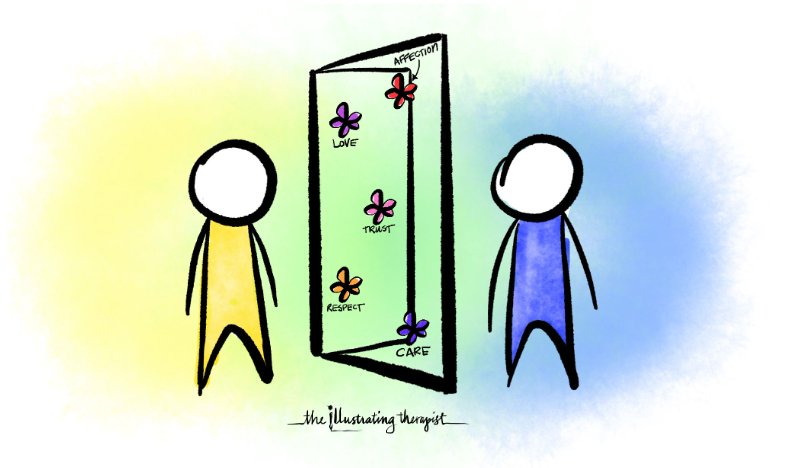
Love, Respect, Affection, Trust, Care – they can't be demanded. They can't be argued into existence. They grow in the right conditions — when both people feel safe enough to stay in their own rooms and tell the truth about what's there.
For more illustrated explanations of relationship patterns like this one, visit my YouTube channel: The Illustrating Therapist.
Comments